
Behind the Thrill: The Safety Engineering That Powers the i-Ride Flying Theater

Written by Huiwen Hu
Case Study: Client Project
Client | Brogent Technologies |
Industry | Entertainment / Amusement Rides |
Challenge | Validate the safety and structural integrity of a seix-actuator flying theator platform to meet international certification standards. |
TOPU's Role | Computer-aided engineering (CAE): Structural analysis, dynamic simulation, fatigue assessment, and physical test validation |
Outcome | Successful completion of TÜV SÜD certification for i-Ride system (2018) |
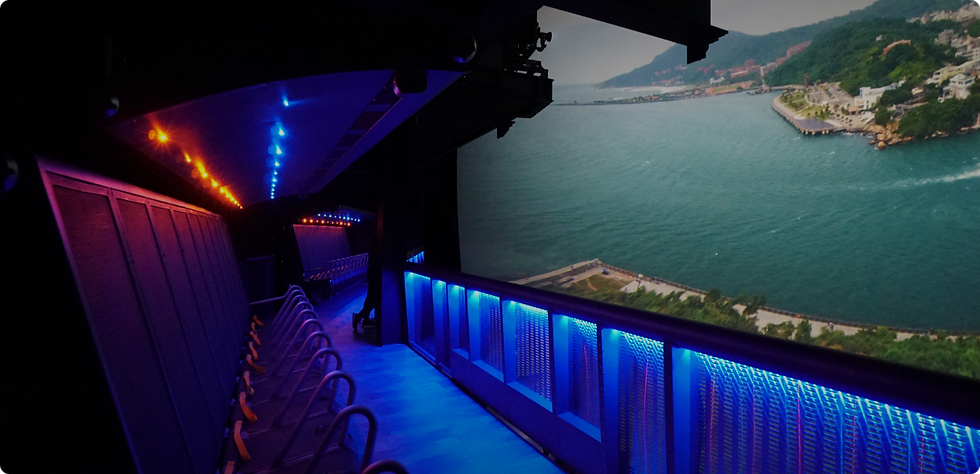
Have you ever sat inside a flying theater and felt like you were soaring over mountains, diving through valleys, or gliding above a city skyline?
That sensation lasts only a few minutes, but making it feel real takes far more than stunning visuals and special effects. Behind every movement is a carefully engineered system, backed by extensive simulation, testing, and validation.
Developed by Brogent Technologies, the i-Ride flying theater has been installed at major attractions and theme parks around the world. But no matter how immersive the ride, one requirement always comes first: passenger safety. TOPU supported Brogent with computer-aided engineering, including structural analysis, dynamic simulation, and physical test validation, work that helped the i-Ride system complete TÜV SÜD certification in 2018.
Creating the Sensation of Flight
At the heart of the i-Ride experience is a six-degree-of-freedom parallel motion platform. Driven by six actuators, it reproduces motion in six directions: forward and back, left and right, up and down, plus roll, pitch, and yaw.
These movements sync with a large curved screen, surround sound, wind, water mist, and scent, creating full immersion without 3D glasses. But the more realistic the ride, the greater the engineering challenge. Every dive, turn, climb, and descent generates forces in different directions, and over years of repeated use, the supporting structure, welded joints, actuators, and mechanical connections must withstand an enormous number of load cycles. The system has to be built not just for strength, but for long-term durability and fatigue resistance.
Designing for Safety Before the First Ride
Traditional product development often means building a prototype, testing it, tweaking the design, and testing again. Physical testing still matters, but relying on prototypes alone is expensive, slow, and limited in how many conditions it can realistically cover.
For the i-Ride project, TOPU brought computer-aided engineering (CAE) into the design stage itself. Using physics-based digital models, TOPU's engineering team evaluated overall system loads, structural deformation, stress distribution, and the fatigue life of critical welded joints:
Fatigue assessment of steel structures and welded details referenced EN 1993-1-9
Local component strength was evaluated with support from the German FKM analytical strength assessment guideline
System-level safety considered the applicable requirements for amusement rides, including the principles covered by EN 13814
Combining system-level safety assessment with detailed structural analysis meant potential weaknesses could be caught much earlier in development.
Hundreds of Load Cases, One Goal
A flying theater doesn't run under one simple loading condition. Every ride sequence combines a different mix of acceleration, direction, platform position, passenger loading, and actuator response, and emergency stops and failure conditions have to be accounted for too.
To capture that complexity, TOPU's engineering team built hundreds of load cases based on different flight sequences and operating scenarios, covering normal operation, demanding motion sequences, emergency conditions, and select failure cases. This let engineers evaluate the available safety margins before the system ever went into service. Passenger dummy models (Dummy III) were also brought into the dynamic simulation to estimate the acceleration, forces, and potential injury passengers might experience in both normal and abnormal operation.
Simulation Must Be Confirmed by Testing
Simulation is powerful, but it's not the final word. Even a highly detailed digital model has to be checked against real-world measurements before engineers can trust its predictions.
TOPU helped establish a dynamic measurement and validation process for the i-Ride system, measuring platform acceleration, position, orientation, structural strain, and actuator behavior across different ride sequences, then comparing that data against the simulation results. Rather than looking at just a single peak value, engineers examined the full time history of the response, including peak values, motion trends, phase differences, and frequency characteristics. This confirmed whether the numerical model actually reflected how the physical system behaved, and gave engineers what they needed to refine the model for future design decisions.
Passenger Safety Is More Than a Single G-Value
In a dynamic ride system, safety can't be judged by the highest acceleration number alone. Direction matters too, since the human body responds differently to vertical, lateral, and longitudinal loads. Engineers also have to factor in how long the acceleration lasts, how quickly it changes, the passenger's seated position, the support from the seat and restraint system, and whether the loading repeats.
That's why the safety evaluation looked beyond peak g-force to the complete motion profile a passenger actually experiences, giving a far more realistic picture of how the ride affects the human body.
Engineering for the Worst-Case Scenario
A system isn't safe just because it works under normal conditions. The more important question is: what happens when something goes wrong?
For a six-actuator motion platform, a foreseeable failure might involve one actuator losing power, locking in place, losing its control signal, or moving unexpectedly. During the safety assessment and certification process, single-actuator fault scenarios were analyzed and validated to determine whether the platform could stay controlled, and whether passenger risk could still be kept within an acceptable range if one component failed. It's a core principle of safety engineering: a system has to work correctly, and it has to fail safely.
The Role of TÜV SÜD Certification
TÜV isn't a single EU-issued certification. It refers to a group of German technical inspection organizations, including TÜV SÜD, TÜV Rheinland, and TÜV NORD. For the i-Ride project, the relevant body was TÜV SÜD.
Certification provided an independent technical assessment that supported the system's acceptance in international amusement markets, and it required far more than a simulation report; it meant structural assessment, motion evaluation, physical testing, failure analysis, documentation, and verification. In 2018, Brogent successfully completed the TÜV SÜD certification process for the i-Ride system, backed by the engineering analysis and validation work carried out with TOPU.
From CAE to Digital Engineering
CAE is sometimes seen as just a tool for calculating stress or deformation, but its real value goes much further. It can connect product requirements, structural design, motion simulation, fatigue assessment, testing, certification, and design improvement into a single digital engineering process, letting engineers catch and fix problems while the product still only exists as a digital model. That means shorter development time, lower prototyping costs, and better-informed engineering decisions. The same approach is now widely used across aerospace, defense, electric vehicles, smart manufacturing, industrial machinery, and large-scale entertainment systems.
Adding AI and Digital Twin Capabilities
The next step in digital engineering is connecting simulation models to real operating data. Machine learning can spot patterns in test and operational data, build faster surrogate models, detect abnormal behavior, and predict future system performance. But a machine-learning model on its own isn't a digital twin. A true digital twin needs an ongoing connection between the physical system and its virtual counterpart, where operational data continuously updates the model, estimates the system's current condition, predicts future behavior, and informs maintenance or operational decisions.
By combining CAE models, physical test data, machine learning, and continuous equipment data, TOPU continues to develop digital twin capabilities as part of its intelligent digital engineering services, supporting customers from product design and production management through equipment monitoring, cost control, and operational decision-making.
The Bottom Line
When passengers feel the thrill of flying across mountains, cities, and coastlines, they never see the hundreds of load cases, the fatigue calculations, the strain gauges, the acceleration measurements, or the failure analyses behind it. They just expect the ride to feel smooth, exciting, and safe.
That's the real measure of good engineering: not just creating movement and visual impact, but making sure every structural component, actuator, welded joint, control response, and safety mechanism performs exactly as intended. The best safety engineering is the kind passengers never notice, and it's exactly what lets every visitor sit back and enjoy the ride with total confidence.


Comments